
Stop Resetting Wrong
A monthly system for habits that actually match your capacity

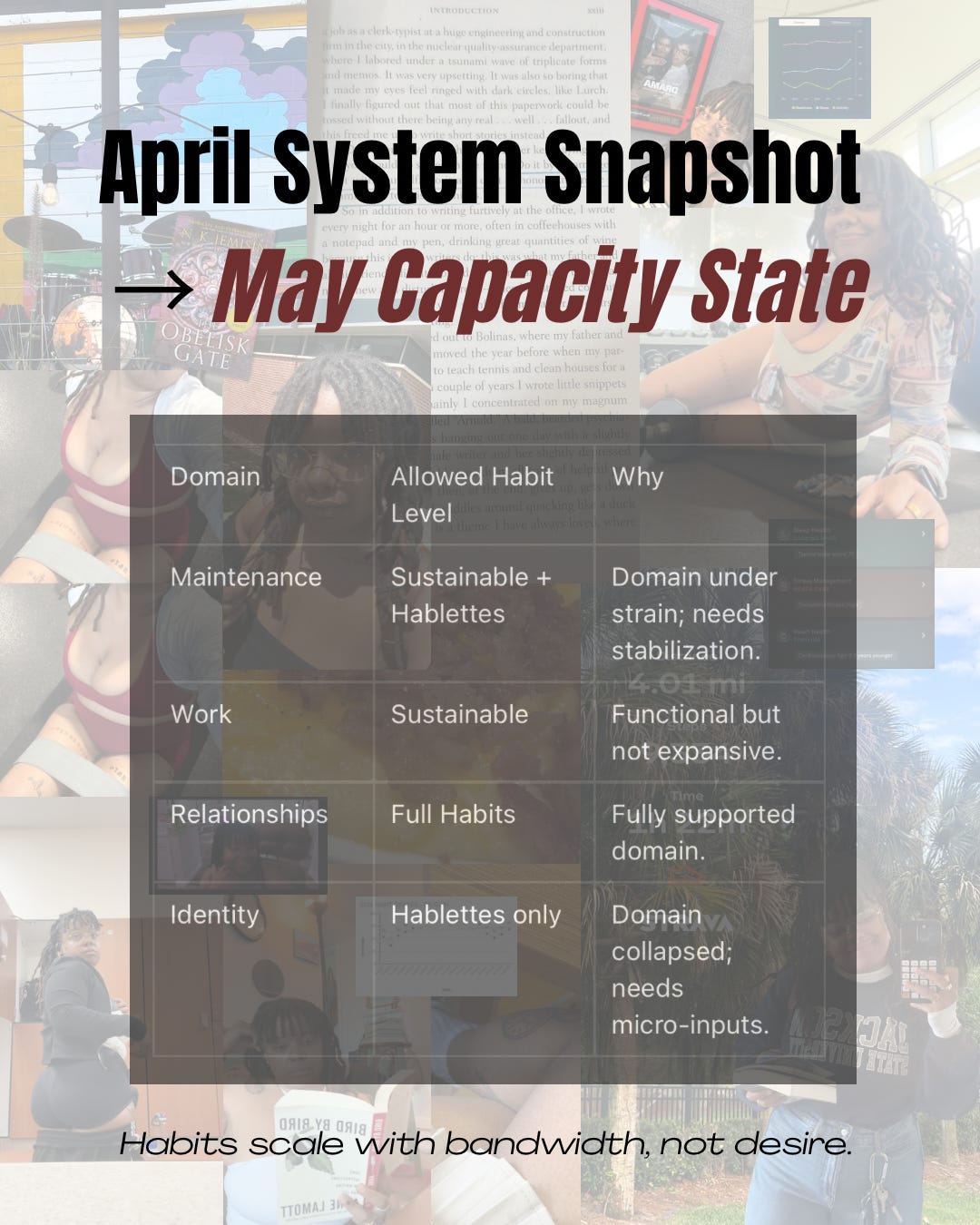
At the start of April, I set out to make Spring feel better than Winter, aiming to implement interventions throughout Quarter 2 that would get me out of the negative behavioral patterns I was slipping into during Quarter 1. This goal led to a series of realizations about my approach to productivity, work life balance, and career ambition that have shifted my approach to my entire framework of Mathematical Productivity (MP).
Habit tracking is a common practice in the productivity space, but what makes MP different from the usual habit tracker’s reflection is how it takes the data collected via habit tracking into applied mathematics. If you’ve been following my resets through my YouTube channel or this Substack, you know I give myself a letter grade every month based on my habits. Every week my habits get a score and this weekly data collection allows for pattern analysis over time that can create actionable changes from those insights.
For years now, I’ve recorded my weekly grade and treated these habit grades as performance scores: an A meant I was ‘on it,’ C meant I was slipping, and F meant I’d failed myself.


But that framework was incomplete. The weekly grade is not actually a moral indicator.
It’s a capacity indicator.
With 2 years of my own data and observations from WPP member scores in our annual review, seeing how low grades always seemed correlated with stress or busy seasons, it’s become clear to me that a low weekly grade doesn’t mean you lack discipline. It means that some life domain was under‑resourced. Conversely, a high grade means the system had support, not that you were somehow more worthy that month.
Once I started seeing my grades as capacity signals instead of moral judgments, everything shifted. I’ve stopped asking, ‘Why can’t I do more?’ and started asking, ‘What can my system actually hold right now?’

That’s the foundation of the Systems Balance Model, and you’ll see it woven into this month’s reset. We will still be doing the same 5 Steps but this is the lens I’ll be using from here on out. If it feels new, don’t worry — I’ll explain the full evolution in my upcoming May essays so you can follow the shift step by step and integrate it gently into your own life if you’d like.
⚖️ THE SYSTEMS BALANCE MONTHLY RESET
The Systems Balance Monthly Reset is a 5‑step monthly ritual designed to regulate your whole life system instead of just your habits. It merges my original Mathematical Productivity framework with the new Systems Balance Model to create a monthly cycle that is diagnostic, sustainable, and season‑aligned.

Most people set goals in a vacuum, then wonder why they can’t execute.
You set goals → but don’t know how to scale them → execution becomes inconsistent.
This framework is the bridge between insight and action, created to help you (and me) understand what your lifestyle system needed, how it performed, and what it can realistically hold next month. Using this framework:
You set goals → run them through this system → each goal becomes a habit level → execution becomes aligned with your actual bandwidth.
This is the missing link between “I know what I want” and “I can actually do this.” The 5‑Step Monthly Reset was already a systems‑thinking ritual but the Systems Balance Model gives us the language and structure to evolve it from a “productivity routine” into a monthly systems‑regulation protocol.
THE CORE OF THE SYSTEMS BALANCE MODEL
I. Core Principles (Evidence‑Based)
1. Balance = Functional Load Distribution
From systems theory: a system is “balanced” when its components operate within capacity, not when they receive equal input.
2. Humans Operate in Capacity States
From allostatic load research: cognitive, emotional, and physiological resources fluctuate across time.
3. Behavior Must Match Available Resources
From cognitive load theory: overloaded systems fail not from lack of desire, but from lack of bandwidth.
II. The Four Domains (Behavioral Ecology)
Functional Load Distribution
Every life system has four domains that must stay functional:
Physiology Maintenance (Foundational Load): sleep, food, health, home
Work & Ambition (Cognitive Load): career, projects, learning
Relationships (Emotional Load): friends, family, community
Creativity & Identity (Intrinsic Motivation Load): creativity, hobbies, self‑expression
Each domain draws from a different “resource pool.” This means Balance = managing cross‑domain interference.


III. Capacity States (Based on Allostatic Load)
Measurable system cycles look like:
High Capacity (growth, expansion): low stress load, high executive function, stable routines, adequate sleep, emotional bandwidth available
Medium Capacity (consistency, maintenance): moderate stress, stable but limited cognitive bandwidth, routines mostly in tact
Low Capacity (stabilization, conservation): high stress load, sleep disruption, emotional exhaustion, reduced working memory, decision fatigue
IV. Domain Balance Check (Monthly) — A Feedback Loop
Available Resources
Borrowing from cybernetics and EMA (ecological momentary assessment):
For each domain, ask:
Functionality: Did this domain operate without breakdown?
Load: Did it demand more resources than available?
Interference: Did it impair another domain?
Alignment: Did its demands match my capacity state?
This creates a closed feedback loop, which is how real systems self‑correct. Domain Grades (A–F) become signals instead of judgments.
V. Habit Hierarchy (Micro-Level Behavioral Design)
Resource Allocation
Grounded in Fogg’s Behavior Model and identity‑based habits, habits scale with capacity inside each domain:
Full Habit: high ability, high motivation, low friction
Sustainable Habit: moderate ability, moderate friction, stable identity reinforcement
Hablette (tiny-habit): minimal ability required, extremely low friction→ This is the scientifically validated “minimum viable behavior.”


⏱ THE SYSTEMS BALANCE MONTHLY RESET
The original 5 steps, upgraded to match the Systems Balance Model
The merge works by adding four new elements to each step:
Domains
Capacity State
Domain Grades
Habit Hierarchy Levels
⏱️ Estimated Time to Complete a Monthly Reset: 35–55 minutes (depending on how much data you track + how reflective you get)
STEP 1: REVIEW → Systems Review
Original question:
What were my goals? Did my actions align with my promises?
Upgraded question:
How did each domain function this month, and did my habits match my capacity?
Purpose: Diagnose system health, not your willpower. You’re no longer asking “Did I try hard enough?”. You’re asking “Did my system have the resources?” . This removes guilt and adds diagnostic clarity.
What this step becomes:
1. Review your goals
April Goals:
write: zero draft act I of my novel → 🚫 changed 🚫
write: prose draft act I of my novel → 🚫 changed 🚫
read: Broken earth book 2 → ongoing 🌱
read: Bird by Bird → ongoing 🌱
3 mile walk challenge ❌
workout 5x a week → score shown later 🌱
apply to 10 jobs ✅
finish my klebsiella model paper → 🚫 changed 🚫
post weekly on YouTube ✅
post weekly on Substack → 2/4 ❌
post weekly on Patreon ✅
2. Analyze your habit tracker (same as before)
I’ve been tracking my habits since 2016 in my bullet journals but as I’ve gained knowledge on systems theory + analysis, I’ve come to apply those skills to the data that’s created from this weekly tracking.
Weekly Habit Analysis:
I track my habits weekly and share them in Q’s Weekly Review. Each habit has a set number of days to be met (e.g. lifting 5x a week vs walking 7x a week). The “grade” or “score” for that habit is the (number of days actually met)/(number of days to be met).
The score for that week is the average of all habit’s progress [ score 1 + … + score n ] / (n). This score for the full week is what’s used for the letter grade of that week A-F on a 10 point scale. I use this score to measure my capacity for that week, paired with weekly reflections to give context to that behavior.
My four grades for April were an 60 (D) -> 52(F) -> 59 (F) -> 69 (D).
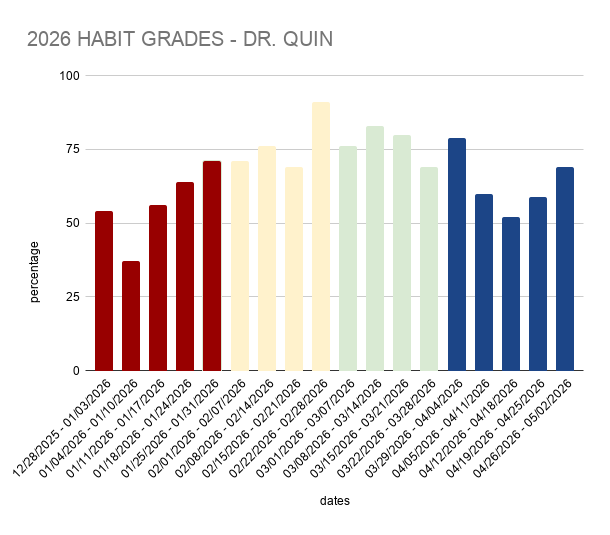
The weekly grades show that my capacity started shaky at the 60%, dropped the following two weeks due to stress, and then increased the final week to its highest at 69% thanks to some stress relief (renewed my job contract!).
Monthly Habit Analysis
While the weekly grades help me see my capacity trend over the month, it’s also important to me to see the snapshot summary of my capacity. This makes it easier to compare months to each other and zoom out to observe a wider pattern.


MAINTENACE DOMAIN HABITS:
M : 7 hours sleep = 17 / 30 =0.567
M : skincare = 23 / 30 =0.767
M : gua sha = 2 / 30 =0.0667
M : strength training = 18 / 22 =0.818
M : 90+g protein = 21 / 28 =0.75
M : 11, 000 steps = 15 / 30 =0.5
M : 30 min zones = 22 / 30 =0.733
57+77+7+82+75+50+73 =421
421/7=60.143 = D
IDENTITY DOMAIN HABITS:
I : daily planning = 27 / 30 =0.9
I : the daily column = 28 / 30 =0.933
I : reading =13 / 30 =0.433
I : writing = 13 / 30 =0.433
90+93+43+43=269
269/4= 67.25 % = D
WORK DOMAIN HABITS :
research career = 17/22 =
77% = C
RELATIONSHIP HABITS :
relationships / community = 29 / 30 =
97 % = A
TOTAL AVG:
57+77+7+82+75+50+73+90+93+43+43+77+97= 864
864 / 13 = 66.462
Comparatively:
FEBRUARY 2026 GRADE: 77% = C 🟡
MARCH 2026 GRADE: 76% = C 🟡
APRIL 2026 GRADE = 66% = D 🔴
3. Grade each domain (A–F) & Note which domains were overloaded vs. under‑resourced
Criteria:
Domain Strain = Domain Grade
A= stable
B= mild strain
C= moderate strain
D= high strain
F= overloaded / neglected
APRIL Domain Grades
Maintenance → 60% → D (under‑resourced) 🔴
This domain didn’t get enough support to stay stable. The basics are functioning, but only because I pushed, not because the system had the resources.
Work → 77% → C (functional but strained) 🟡
This domain is getting done, but it’s costing me. I can perform here, but only at a sustainable level, not an expansive one.
Relationships → 100% → A (stable) 🟢
This domain is healthy and self‑maintaining; it can hold full habits without draining the rest of the system.
Identity → 67% → D (under-resourced) 🔴
This domain didn’t get enough support to stay stable for normal habits. It needs micro‑inputs (hablettes) to come back online.
4. Identify your monthly capacity state (High / Medium / Low)
Criteria:
Capacity state = Habit Average
Low: 0-40%
Med: 41% - 70%
High: 71% - 100%
APRIL Capacity State = 66.462 = D = Medium 🟡
My system is showing a Medium → Low Capacity pattern because:
Maintenance is struggling
Identity is severely under-resourced
Work is functional but not thriving
Only Relationships are stable
This means: I can still grow but only in 1–2 domains. Everything else must be scaled down.
5. Determine System Load from Domains
Criteria:
System Load = Domain Strain Total
Light: 0-1 C grade or below
Moderate: 2 domains C or below
Heavy: 3-4 domains C or below OR any at F
APRIL SYSTEM LOAD: 3 domains strained = Heavy Load 🔴
6. Mark Capacity x Load Indicator
Criteria:
Capacity x Load Matrix
Low C x Light Load = recovering
Low C x M Load = overwhelmed
Low C x H Load = burnout zone
Med C x Light Load = stable
Med C x M Load = strained
Med C x H Load = at risk
High C x Light Load = thriving
High C x M Load = overcommitted
High C x H Load = overexerting
APRIL SYSTEM STATE: Medium Capacity 🟡 x High Load 🔴
= At Risk
STEP 2: REFLECT → Systems Reflection
Original question:
How did I feel? What do I want to remember?
Upgraded question:
Which domains generated these feelings, and what signals did they send?
Purpose: Turn emotions into system signals. You’re mapping emotional load → domain health. This turns reflections into data instead of just vibes.
What this step becomes:
Positive feelings → tag the domain
Negative feelings → tag the domain
Accomplishments → tag the domain
Looking forward → tag the domain
I completed this step during my April reflection:
A lot of my positive feelings came from memories associated with the Maintenance and Relationship domains: fun workouts, social gatherings, confidence from accomplishments. The negative feelings were primarily associated with Work/Ambition and Maintenance (sleep) domains as those gave me the most stress throughout the month.
My accomplishments this past month were primarily Work & Ambition and Relationship domains, with wellness and creativity suffering greatly to get much actually finished personally. Perhaps that’s why most of the things I’m looking forward to are in the Relationships and Identity domains — events, reading and writing progress, self care.
Maintenance → positive feelings, negative feelings
Work & Ambition → negative feelings, accomplishments, positive feelings
Relationships → positive feelings, accomplishments, looking forward to
Creativity & Identity → looking forward to
What signals does this send?
This tells me that I need to stabilize maintenance & work so that I can have capacity for relationships and creativity. The job market stress has lightened for now so I can use that to rebalance strain against maintenance.
STEP 3: REALIGN → Systems Realignment
Original question:
How can I move the needle toward my goals?
Upgraded question:
Given my capacity state, which domains can grow next month — and which must stabilize?
Purpose: Align ambition with bandwidth. You’re no longer setting goals in a vacuum. You’re setting goals that match your season. This prevents burnout and keeps ambition sustainable.
A monthly goal becomes a Full Habit, Sustainable Habit, or Hablette depending on your capacity state and the domain’s monthly grade.
How Habit Hierarchy Fits Into Monthly Goals
1. Every monthly goal belongs to a domain. Example:
“Post 5 YouTube videos” → Work & Ambition
“Read 2 books” → Identity
“9k step challenge” → Maintenance
2. Each domain gets a monthly grade (A–F).
This tells you whether the domain is:
A–B: stable enough for growth
C: needs maintenance
D–F: needs conservation
3. Your capacity state sets the ceiling.
High capacity → Full Habits allowed
A + B
Medium capacity → Sustainable Habits only
C
Low capacity → Hablettes only
D–F
The habit hierarchy is how you scale the monthly goal.
Example:
MAINTENANCE (Domain Grade: D → Hablettes Only)
Even though some habits scored well individually, the domain is under‑resourced.So everything must shrink to Hablettes except the stabilizers.
Habit Translation:
Goal → Habit Level → Action
7 hours sleep → exception: stabilizer so Sustainable → aim for 7 hours
Skincare → hablette → 1-2 step routine
strength training → exception: stabilizer so Sustainable → 1-2 sets per exercise
others → hablettes → decide a range of action e.g. 80-100g protein
What this step becomes:
Set monthly goals & assign each goal to a domain

MAY GOALS:
health goals: → PHYSIOLOGICAL MAINTENANCE DOMAIN
11,000 step avg #HABIT
7 hrs sleep avg #HABIT
100g protein avg #HABIT
half marathon training plan #HABIT
B Block strength training plan #HABIT
books I want to read: → IDENTITY DOMAIN
The Obelisk Gate by N.K. Jemisin — sci fi fantasy
The Stone Sky by N.K. Jemisin — sci fi fantasy
Bird by Bird by Anne Lamott — writing craft nonfiction
Writing Down the Bones by Goldberg — writing craft nonfiction
All The Sinners Bleed by S.A. Cosby — thriller fiction
Notes on Camp by Susan Sontag — nonfiction
work goals: → WORK & AMBITION DOMAIN
submit SCDPAIN biosketch application
new full draft of KLB manuscript w results
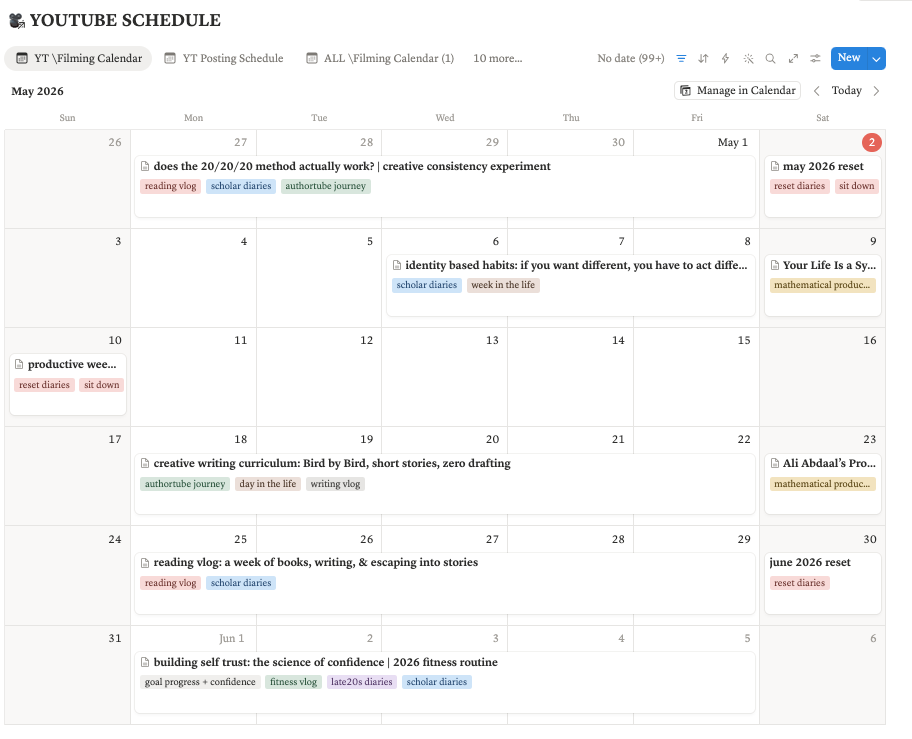
4 YouTube videos
4 Patreon videos
4 Substack essays
creative goals: → IDENTITY DOMAIN
outline chosen short story
zero draft short story
read 2x4 short stories
novel world building & outlining updates only
Adjust the habit hierarchy inside each domain:
[Full Habit // Sustainable Habit // Hablette]
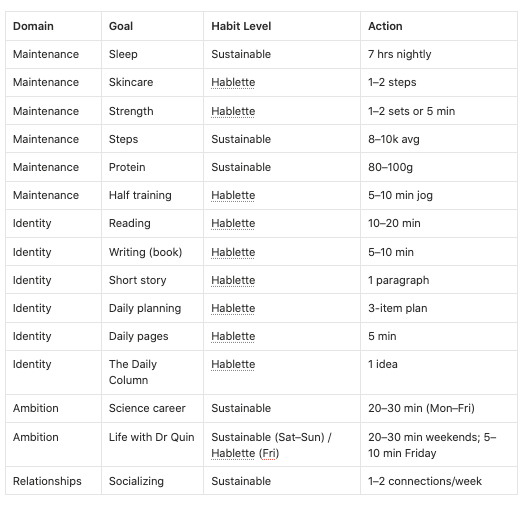
The monthly habit translation table is the stable reference point — the part where your goals get scaled to match your actual capacity. Weekly capacity will rise and fall, but the monthly table anchors your goals, sets the correct habit size, prevents you from expanding impulsively, and keeps you aligned with your long‑term direction
The monthly table is the strategy you return to when the week gets chaotic. This is the cornerstone of the model:
habits that fit the season you’re in, not the one you wish you were in.
STEP 4: RESET → Systems Reset
Original question:
What do I need prepared so I succeed?
Upgraded question:
What structural adjustments does my system need to support my domain priorities?
Purpose: Rebalance the system architecture for the month ahead.
What this step becomes:
Update calendar
Time‑block ideal week
Choose anchor habit
Brain dump tasks
Plan weekly tasks
Plus one new layer:
Identify which domains need buffers (extra rest, fewer commitments)
Identify which domains need activation (more structure, more inputs)
🔑 May System Update:
Maintenance = D → Buffer domain
Identity = D → Buffer domain
Ambition = C → Activation domain
Work = C → Activation domain
Relationships = A → neutral/stable
This means:
Maintenance and Identity must stay small all month.
Ambition and Work can grow, but only at Sustainable levels.
⚙️ MAY PROJECTED STATE:
Capacity: Medium (same as April)
Load: Moderate (due to habit translation table)
→ Medium Capacity × Moderate Load = Strained (but Stable)
This is a much safer state than At Risk.
✅ STEP 5: RESTART → Systems Restart
Original question:
How can I make the positive things easier and negative things harder?
Upgraded question:
How can I adjust my environment to support the domain hierarchy for this month?
Purpose: Align your environment with your capacity state. You’re engineering your environment to match your system’s season.
What this step becomes:
Clean your environment
Choose a habit you can check off today
Plus one new layer:
Align your environment with your capacity state
Make sure your space supports the domains that are in growth mode
Reduce friction for your sustainable habits + hablettes. Add a quick note on:
what you’re making easier
what you’re making harder
what you’re removing friction from
what you’re adding support to
And that’s my Systems Balance Reset for the month.
I hope this approach, gives to you what it has given me:
a clear picture of my system’s health
a guilt‑free explanation for low‑capacity months
a sustainable path toward long‑term goals
a language for understanding my life
a monthly ritual that keeps my life system functional, flexible, and honest
This is balance redefined as system functionality across seasons instead of perfection.
I’ll be sharing more about how this model works, why I built it, and how you can use it in your own resets in my May publications. This is just the beginning of the evolution.
WHAT THE SYSTEMS BALANCE MODEL IS NOT
(Clarity statements to prevent misinterpretation)
1. It is not a productivity system.
It doesn’t exist to make you do more.
It exists to help you understand what your system can hold.
2. It is not a discipline test.
Low capacity doesn’t mean low character.
It means your system needed support, not pressure.
3. It is not a performance scoreboard.
The grades aren’t about how “good” you were.
They’re about how resourced each domain was.
4. It is not a self‑optimization challenge.
There is no “perfect month.”
There is only system functionality across seasons.
5. It is not a way to justify overworking.
High capacity is not a green light to overload yourself.
It’s a season, not a mandate.
6. It is not a rigid structure.
It adapts to your life, your energy, your season.
It’s a lens, not a cage.
7. It is not a replacement for intuition.
It works with your lived experience, not against it.
The model gives language to what your body already knows.
8. It is not a moral hierarchy.
A domain in collapse doesn’t mean you failed.
It means that part of your life needs gentleness and micro‑inputs.
9. It is not about “fixing” yourself.
It’s about understanding your system so you can support it.
Not punish it.
10. It is not a monthly reinvention ritual.
It’s a monthly regulation ritual.
The goal is stability, not constant transformation.
So excited to start implementing these strategies into my habit tracking systems! Thank you Dr. Quin!!